


🏡 🏡 The 50-Year Mortgage: Game Changer or Gimmick?
- Nov 24, 2025
- 3 min read
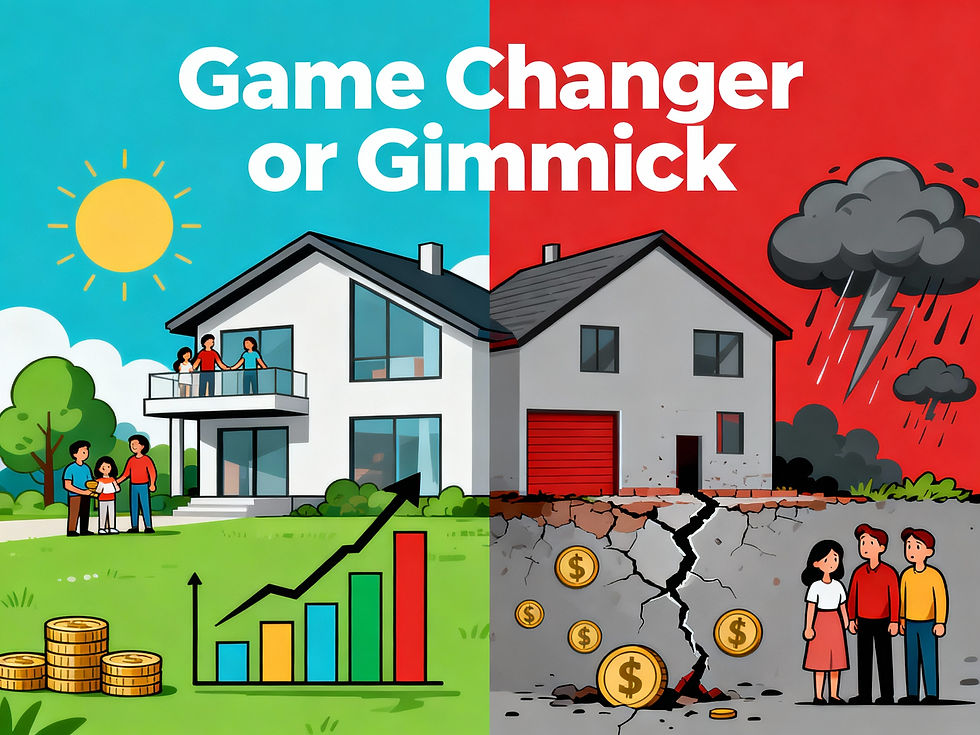
💭 The Idea Behind the 50-Year Mortgage
With rising home prices and interest rates, affordability is a major challenge for homebuyers — especially first-timers.
Trump first touted about it coming, and now everyone is talking about the idea of a 50-year mortgage as a way to alleviate the burden of unaffordability by reducing one’s monthly payment and “open the door” to homeownership.
On paper, it sounds like a creative fix. But as with anything in lending, there’s more beneath the surface.
✅ The Potential Pros:
1️⃣ Lower Monthly Payments
The biggest appeal is simple: spreading your loan balance over 50 years means smaller payments.That could make it easier for some buyers to qualify — or free up room in the budget for other expenses.
2️⃣ Easier Entry for First-Time Buyers
If the 50-year term were ever approved and widely adopted, it might help more people get into homes who otherwise couldn’t afford one under a 30-year term.
3️⃣ Increased Flexibility in Expensive Markets
Markets like Dallas-Fort Worth, California, and Austin are seeing high prices relative to income. A longer term could offer some breathing room for buyers who plan to refinance or move before paying it off entirely.
⚠️ The Cons (and They’re Big Ones)
1️⃣ You’ll Pay Way More in Interest
The longer the loan, the more interest accrues — and the slower you build equity.Over 50 years, you could easily pay hundreds of thousands more than you would on a 30-year loan.
2️⃣ Minimal Equity Growth
In the early years, most of your payment goes to interest, not principal.With a 50-year amortization, that balance moves even slower. Meaning? You could own your home for a decade and still owe almost what you started with.
3️⃣ Harder to Build Wealth
One of the biggest advantages of homeownership is equity. Stretching your loan out that long delays one of the key benefits of owning a home.
4️⃣ Market Acceptance and Resale Issues
There’s currently no secondary market for 50-year loans — meaning investors aren’t lining up to buy them from lenders. Without that, these loans would come with even higher rates, limited availability, and ultimately make them an unappealing option.
🧮 Real Talk: How a 50-Year Term Would Change Mortgage Economics
Behind every mortgage is an investor — someone buying that loan as part of a portfolio or mortgage-backed security.And here’s where the economics get tricky:
The shorter the loan term, the faster investors recoup their capital. That’s why 15-year mortgages often have lower interest rates than 30-year loans — they’re less risky and more appealing to investors.
A longer mortgage term (like 50 years) increases risk. Over half a century, a borrower’s chance of job changes, illness, or life events is much higher — and that increases the likelihood of delinquency; using the same approach of 15-year rates being lower than the 30-year rates, the likelihood of rates being higher on the 50-year compared to the 30-year is damn near guaranteed, ultimately eating into the ‘lower monthly payment’ that the 50-year mortgage is seemingly hoping to provide.
A 50-year mortgage also faces challenges from inflation and the time value of money — meaning that a dollar paid 40 years from now is worth much less today.
Finally, there’s currently no established secondary market for 50-year loans. It would take (a long) time, new regulation, and major investor participation to create enough liquidity to make them efficient or affordable.
Simply put: longer doesn’t always mean better — for either the borrower or the investor.
🏁 The Bottom Line
A 50-year mortgage might sound like a creative solution, but it’s more of a bandage than a cure. While it could make short-term affordability easier, it comes with long-term costs — slower equity growth, more interest, and structural risk for both homeowners and investors.
If affordability is the challenge, there are smarter ways to get creative — from down payment assistance to rate buydowns, shared equity programs, or first-time buyer tax credits.
💬 Want to Explore Your Smartest Options?
Let’s talk about strategies that help you buy responsibly — not just affordably.I’ll walk you through what works today and what keeps your financial future secure tomorrow.
📞 Call/Text: 925-305-6639
📧 Email: swhiting@loandepot.com
🌐 Apply: www.homeloansbystephanie.ninja
📅 Schedule a Call: Book a time here
Comments